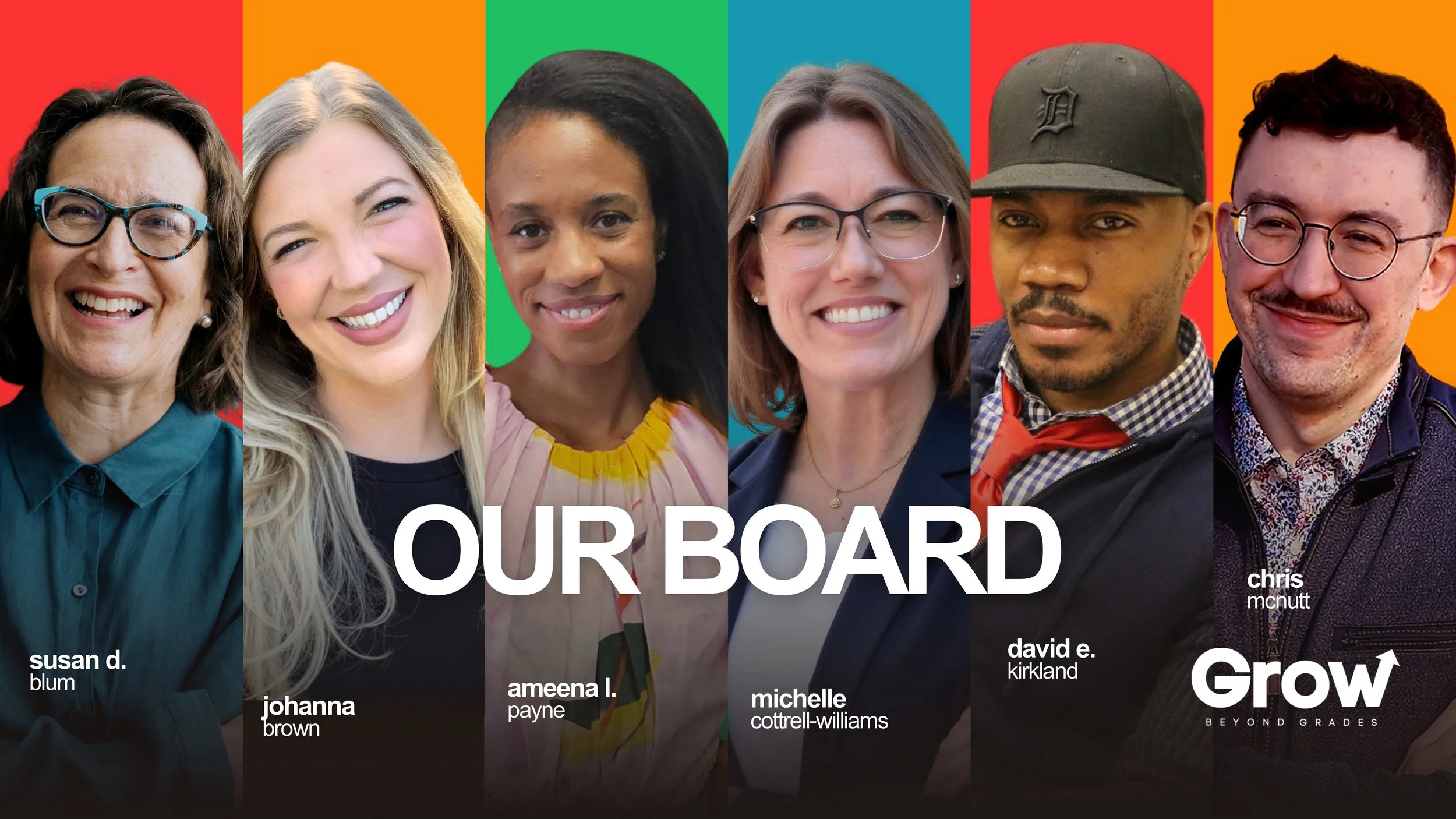
Meet Our Board!
What if assessment existed not primarily to sort learners, but to deepen learning, nurture agency, and make education more just?
—David E. Kirkland
How did you become involved in gradeless learning and Grow Beyond Grades?
Michelle Cottrell-Williams: I started experimenting with the idea of turning grading into a conversation with each student in the 2015-2016 school year. My son’s birth earlier in the year meant I had a sub for most of the first quarter and then I welcomed a student teacher into my classroom during all of third quarter and half of fourth. As I thought about averaging students’ final grades using only a single quarter of my own evaluations, I decided that it couldn’t be a fair or accurate reflection of their learning for the year. I still point to those year-end grade discussions with my students as one of the most meaningful experiences of my career. After that, I never looked back! How could I give up the chance to connect and reflect with my students like that?
At the same time, I was actively engaged on Twitter in search of building a community with like-minded educators and expanding my access to professional learning. I can’t even remember how I came across Teachers Going Gradeless (the original iteration of Grow Beyond Grades), but I started regularly participating in their Twitter chats. At some point, either Arthur or Aaron Blackwelder sent a message inviting me to join their small but growing group chat of teachers across the country who were interested in gradeless classrooms. I’ve taken on a wide variety of roles since that first Twitter chat, including leading some of those early chats, co-hosting a podcast series and conducting interviews, working with the leadership team as we transitioned from TG2 to GBG, and now serving as the current board president. I’m excited to be part of the next stage of Grow Beyond Grades!
Johanna Brown: The former great world of Twitter brought me awareness of Grow Beyond Grades. I started with a blog about standards-based grading and ended up down the rabbit hole of the original Teachers Going Gradeless site as I sought increasingly meaningful systems to support student learning. The TG2 Twitter chats and posts helped open my eyes to what might be possible in my classroom. What kept me coming back was the beautiful community being built. I found other local-ish ungraders up in the Pacific Northwest, connected with folks nationally and internationally, and felt supported in my work toward increasing student agency. I’m excited about the new book and podcasts to bring in the next generation of educators wanting humane and meaningful learning to happen for their students.
Chris McNutt: I connected with Arthur and Grow Beyond Grades fairly early on, back in the edu-Twitter days, through the shared practices at Human Restoration Project and, at the time, Teachers Going Gradeless. When I was teaching, I came across a range of articles about integrating portfolios into classrooms. That led me into the research, especially Ruth Butler's work, and I became more and more invested in a question that wouldn't let go of me: why weren't we bringing developmental psychology and motivation research into schools, the one space where it seems most relevant?
In my own classroom, I experimented with portfolios and even removed grades entirely before settling on a feedback-driven model. My students achieved way more than they had before, and they actually learned over time rather than turning something in and being one-and-done. I now use Grow Beyond Grades' work in our school partnerships to help spread this practice to classrooms across the US and abroad.
Ameena L. Payne: Like Chris and others, I became involved in Grow Beyond Grades after Arthur invited me to join the community following a thought-provoking interaction on ‘Academic’ Twitter. Our exchange became an extended opportunity to engage with a group of people, via TG2, asking thoughtful questions about assessment and learning in higher education. I became increasingly interested in how students and educators relate to learning through assessment and feedback and how those relationships shape understandings of knowledge and meaning-making.
Around the same time, I was reading the work of scholars, such as Jesse Stommel, Maha Bali, and colleagues in the Network for Relation-Centred Education, whose ideas resonated with many of the questions I was already exploring. My masters and subsequent doctoral research added another layer, with participants sharing stories about their evolving relationships with grades, knowledge and success. Together, these experiences encouraged me to think more deeply about what assessment does and what it makes possible and how it might be approached differently.
Susan D. Blum: I first started to question the conventional education system, in terms of higher education at first, in the early years of the 2000s. I did a research project (and book) about cheating and plagiarism, where I first encountered the work of Alfie Kohn and the question of extrinsic vs. intrinsic motivation. I have since then conducted research among college students and in an internship, and in a lab, to try to understand better what works and doesn't really work. I keep writing about it. I discovered the work of the K–12 gradeless community, which I incorporated into my edited volume, Ungrading: Why Rating Students Undermines Learning (and what to Do Instead) (2020). I have not put a grade on any student work since 2016, though I do have to generate final grades. I have given dozens (maybe even hundreds?) of talks to thousands of educators worldwide about going gradeless, or using alternative assessment, or ungrading. I am excited about this incarnation of Grow Beyond Grades and the effort to make this approach to teaching more broadly known, so that it no longer seems radical, shocking, or irresponsible.
David E. Kirkland: My involvement with Grow Beyond Grades began with an invitation from Arthur, but it resonated because it aligned with work I have pursued throughout my career. I have long argued that many of our educational systems measure students more efficiently than they cultivate them. Grading, as traditionally practiced, too often reflects inherited assumptions about intelligence, merit, and success rather than the complexity of human learning.
My work has focused on transforming systems so they expand opportunity instead of rationing it. That means reimagining the structures, policies, and practices that shape students’ experiences—not simply improving outcomes within systems that were never designed for everyone to flourish. Gradeless learning (or equitable systems for feedback) represents one important expression of that broader commitment. It challenges us to ask a more fundamental question: What if assessment existed not primarily to sort learners, but to deepen learning, nurture agency, and make education more just? That question has animated my scholarship and practice for decades, which is why saying yes to Arthur felt less like taking on something new than continuing a conversation I have been having all along.
I couldn’t keep trying to make the child change. Instead, I needed to be the one to change.
—Michelle Cottrell Williams
How have you sought to grow beyond grades in your own teaching or career? How has this coincided with your goals as an educator?
Chris McNutt: My work now centers on integrating portfolio-based assessment into classrooms through our explicit research study on how shifting away from grades changes the learning environment. Between what I saw in my own classroom and what I've seen since, partnering with districts on these systemic changes, two things have become clear to me: First, grades are such a powerful extrinsic motivator, and so tightly bound up with a student's sense of self-worth, that they damage both the ability to learn and social-emotional health. Second, grades rarely offer an accurate picture of what a student can actually do. They often lead kids to give up early, which defeats the whole purpose of schooling.
The research keeps confirming what this points to: moving away from grades, focusing on growth, and elevating student agency leads to better well-being, engagement, and motivation. Those are exactly the things we need right now to build a better world.
Ameena L. Payne: Growing beyond grades has been less about adopting a particular assessment approach and more about becoming increasingly curious about the relationships that form around learning. My teaching, doctoral research and involvement in scholarly communities and other ‘third space’ work all played a part. Mentorship has also played an important role in shaping my thinking. Over the years, I have experienced mentorship as both a mentee and a mentor, and those relationships have repeatedly reminded me that learning is rarely a solitary endeavor. Many of my most significant insights have emerged through conversations with colleagues, students, research participants and scholarly communities.
I have been fortunate to learn alongside generous colleagues, scholars and critical friends who encouraged me to examine assumptions I had taken for granted about assessment, becoming, expertise, and learning. Those conversations often led me back to similar questions: What becomes possible when learning is not organized primarily around performance? What kinds of educational futures are we cultivating?
As I move into learning design, those questions remain with me. They continue to shape my interest in creating educational environments that support dialogue, reflection and meaningful engagement with learning.
David E. Kirkland: I have refused to confuse evaluation with education. Throughout my career, I have worked to create learning environments where curiosity is valued over compliance, growth over performance, and intellectual courage over the pursuit of the “right” answer. Rather than asking students simply to demonstrate what they know, I have tried to help educators help students become people who know how to inquire, question, create, and contribute.
That commitment has always aligned with my broader goals as an educator/scholar/justice advocate. I believe the purpose of education is not to produce transcripts but to cultivate thoughtful, capable, and compassionate human beings who can participate meaningfully in a democratic society. Grades can sometimes serve a practical function, but they become problematic when they eclipse learning or even the human experience, which education should enhance. My work has therefore centered on designing systems where assessment becomes a tool for reflection, feedback, and growth rather than judgment alone.
Ultimately, I have wanted students to inhabit classrooms where they are promised the properties of more than knowledge. I have wanted them to leave with a stronger sense of agency, a deeper belief in their own capacity to learn, and the confidence to imagine possibilities beyond the limits that institutions—or even they themselves—may have once believed were fixed.
We don't need grades to make students amazing. They already are.
—Johanna Brown
What is one educational experience—as a student or educator—that fundamentally changed how you think about assessment?
Michelle Cottrell-Williams: One afternoon when my kids were much younger, we were sitting together watching Justin Time, a Disney Junior show in which the main character, Justin, traveled with his friends Squidgy and Olive to different time periods. Each adventure taught him to solve a problem he was facing back home. In this episode, Justin traveled to the prehistoric era and tried playing with Olive’s pet dino Rexy. They first tried hide-and-seek and, as you can imagine, Rexy wasn’t very good at hiding. Part of his body was always visible and the kids easily found him. When they tried playing tag, the kids couldn’t keep up with Rexy. During mini-golf, Rexy’s ball flew way too far. As the kids struggled to find a game they could all enjoy, Justin realized that, “The problem isn’t with Rexy, it’s with the rules of the games! We need to change the game so he can play!” When I heard that, I sat up, rewound the show, and added a note in my phone. This line perfectly expressed my thoughts about instruction and assessment. When a student wasn’t able to demonstrate their learning, for whatever reason, I couldn’t keep trying to make the child change. Instead, I needed to be the one to change, to figure out how my assessments could better meet that child’s needs and measure their progress.
David E. Kirkland: The experience that most changed my thinking about assessment wasn’t a single moment. My thinking is continuously evolving, shaped by spending years alongside children whose brilliance was repeatedly misrecognized because the systems designed to evaluate them were never designed to fully see them.
As a Black scholar who has devoted his career to questions of justice, I have sat with students whose report cards suggested deficiency while their lives revealed extraordinary ingenuity. I have watched young people translate for their families, navigate neighborhoods marked by concentrated poverty, care for siblings, solve complex social problems, and demonstrate remarkable intellectual dexterity—only to be told by school that they were below standard. The contradiction was impossible to ignore. I realized that what we often call assessment is not simply a measure of learning but also and always an exercise of power. It reflects decisions about whose knowledge counts, whose language is legitimate, whose ways of thinking are rewarded, and whose humanity is recognized.
That realization fundamentally altered my work. I came to see grading not merely as a technical practice but as part of a broader social architecture that too often sorts opportunity along familiar lines of race, class, language, and dis/ability. When those judgments are repeated over years, they do more than describe reality—they produce it. They shape confidence, access, expectations, and ultimately life trajectories. And for too many vulnerable young people, these trajectories are matters of life or death in the most extreme sense.
That is why I continue to advocate for systems that are more human, more intellectually honest, and more just. The question has never been whether we should assess learning. The question, for me, is whether our assessments expand human possibility or merely ratify inequalities that children did not create. How do we interrupt assessment as a system of power and permission? How do we humanize and decolonize the very apparatus of education that allows invisible forces of social maintenance to remain hidden through our consent? Once I understood the distinction between what we assess and how assessment functions as system of power,, I could never think about grading in quite the same way again.
Susan D. Blum: For me it was a gradual loss of belief in the usefulness of grades for motivating students the way I wanted to motivate them (which was out of genuine interest, not fear). I also listened to students talk about how they felt about the whole enterprise of education and their goals, through formal interviews conducted by student ethnographers and my own increasingly honest conversations. I observed the chokehold the obsession with grades had, especially for the highest-achieving students, who had formerly been the ones I identified most with, but who I began to see as not only suffering but also stifling their own desires. I saw that students disregarded comments in favor of fixating on grades. I read and read the literature on grades and motivation and mental health, and also began to understand better the nature of learning. I experimented widely with different kinds of feedback, including what I came to see as most important, self-assessment or reflection.
In many ways it was a true loss of faith, almost in a religious sense, because belief in the necessity and utility of grades has been accepted doctrinally but without a demand for proof (“evidence”), unlike the demand of those proposing alternative assessment methods. Once I began to question the inherited system, its foundations became increasingly problematic. And the alternatives offered fixes, if not true solutions.
Johanna Brown: For me, it was the end of the 2020–2021 school year. As a class, we'd agreed that everyone would earn an A if they showed up, tried, and asked questions when they didn't understand. At the end of that year, my chemistry classes worked together on large-scale research projects—full-sized, academic-conference-style research posters. Not for a grade.
I remember stepping back from the wall after hanging them up and just being struck by how incredible these students were. That moment solidified something for me: we don't need grades to make students amazing. They already are. What we need is to find ways to let them flourish, be creative, and do real work without a rubric hanging over it.
That was my final evidence that students can do genuinely excellent work without the traditional grading structure driving them—and it's why I've never looked back.
Belief in the necessity and utility of grades has been accepted doctrinally but without a demand for proof.
—Susan D. Blum
As conventional grades have increasingly come under scrutiny, many are again turning to standardized testing as a so-called “objective”measure of student learning, college readiness, etc. Why do you believe we need to move toward richer, more humane forms of assessment instead?
Michelle Cottrell-Williams: I think best in analogies! I see the educational system as a series of benchmarks, in the form of grades and standardized tests, that were meant to measure student learning. It’s like a child’s shape-sorting toy, but instead of many differently shaped holes, the holes are all round, a reflection of our society’s desire to hold all students to a predetermined standard of what it says success should look like. However, our students are not all the same, and it can often feel like we are being asked to force our star or square-shaped blocks through round holes. We struggle to get these students to fit through spaces that were built for circles, and then get asked to explain why an achievement gap still exists. Rather than continue churning out a generation of circles, we need to work to intentionally change the shape of the environment. If classrooms are filled with students shaped like stars, triangles, and hearts, we need to build star, triangle, and heart shaped holes. Moving toward richer, more humane forms of assessment gives our students the chance to show us what they know and can do, instead of just expecting them to conform to an ill-fitting shape.
David E. Kirkland: I'm not sure I would begin with the assumption that grades have lost credibility. For many people, grades remain deeply trusted because they are familiar, efficient, and relatively easy to interpret. The larger issue is that neither grades nor standardized tests can bear the weight we ask them to carry. Both offer partial information about learning, yet we often mistake that partial picture for the whole child. And that’s a fundamental problem.
The question, then, is not whether we should replace grades with tests or tests with grades. It is whether we are willing to develop assessment systems that are worthy of the complexity of human learning and systems of feedback that are worthy of our babies. Learning is relational, developmental, and contextual. It includes knowledge, certainly, but also curiosity, persistence, creativity, judgment, collaboration, and the ability to transfer understanding across situations. No single score or letter can fully capture those capacities.
This matters because assessment is never neutral. The ways we choose to measure learning inevitably shape what and how we teach, what students learn to value, and who is recognized as capable. If our measures privilege speed over depth, compliance over curiosity, or narrow demonstrations of knowledge over broader forms of intellectual competence, we shouldn’t be surprised when our systems reproduce those priorities. Of course, this is deeper when we add in the flavors of human bias, interests, and other human evils that are so common that we have become bored naming them.
I believe we need richer, more humane forms of assessment not because they are less rigorous, but because they demand a deeper rigor. They require educators to gather multiple forms of evidence, attend to growth over time, provide meaningful feedback, and exercise professional judgment in partnership with students. They also require us to interrogate our assumptions about learning and the objective fallacy that so much of assessment is based on. Are we grading what really matters? Who gets to decide, and to what end? There are numerous questions like these that need deeper interrogation. The goal is not to lower standards; it is to create assessments that more faithfully represent learning while expanding, rather than constraining, human possibility.
Ultimately, the question is not whether students can produce a score. It is whether our assessments help them become more knowledgeable, more capable, and more fully themselves. That is the measure that matters most.
Ameena L. Payne: For many people, grades and standardized tests remain the familiar and trusted ways of making judgments about learning. What I think is changing is our willingness to question what these measures can and cannot tell us. I find myself interested in what grades do. What forms of learning do they recognize? What relationships do they create between students, educators and knowledge? What possibilities do they open up, and what possibilities do they constrain?
A good friend of mine, Dr. Aris Clemons, has recently reminded me that academia is a mirror of society. That observation stays with me because the assumptions embedded in assessment rarely emerge in isolation. They often reflect broader social ideas about success, productivity, merit and value.
My interest in richer and more humane forms of assessment comes from a desire to create more space for interpretation, dialogue and professional judgment. Learning is often messy and uncertain. I try to unsettle the instinct of treating uncertainty as a problem to eliminate, and I think the process of learning, particularly through assessment and feedback, can help students (and educators) learn how to work with it.
Questions of quality and public trust remain important, particularly in fields such as health and medicine. These contexts remind me that assessment always involves choices about what is recognized, how it is recognized and for whom.
What becomes possible when learning is not organized primarily around performance? What kinds of educational futures are we cultivating?
—Ameena L. Payne
As educators work to grow beyond grades in today’s educational landscape, what should they be paying closest attention to? What concerns you, and what gives you hope?
David E. Kirkland: I'm not convinced either that educators, broadly speaking, are trying to grow beyond grades. Most are doing what dedicated professionals have always done: working extraordinarily hard within systems they did not design. Before we ask educators to abandon grades, though, we have to offer them something more compelling than critique. We have to help them imagine a different possibility.
That begins with a shift in purpose. As Buckminster Fuller said, “You never change things by fighting the existing reality. To change something, build a new model that makes the existing model obsolete.” The future of assessment will not emerge simply by removing grades but by building richer models of learning—models grounded in meaningful feedback, demonstrations of mastery, portfolios, exhibitions, self-reflection, revision, conversations that make thinking visible, and others that are open for us to think of. We need to offer alternative approaches that do more than measure learning but deepen it.
What concerns me is that we often mistake replacing a tool for transforming a system. If we remove grades but leave intact cultures of competition, scarcity, and sorting, we will simply reproduce the same inequities under different names. Real transformation requires us to redesign the conditions of learning, not just its metrics.
What gives me hope is that we already know far more about human learning than our assessment systems reflect. We know that children flourish through belonging, purpose, feedback, challenge, and relationships. We know that growth is developmental rather than linear. And we know that young people become more invested in learning when they have opportunities to revise, reflect, create, and demonstrate understanding in authentic ways.
For me, the ultimate question is wonderfully simple: Does the way we assess our children care for them? Does it cultivate their confidence, curiosity, and capacity? Does it protect their sense of possibility, especially when they struggle? If the answer is no, then we have an obligation not merely to criticize the old model, but to build one that is more worthy of them. Our children deserve assessment systems that do more than judge what they know; they deserve systems that help them become who they are capable of becoming.
Chris McNutt: Building on David's ideas, I think we have to be wary of magic potions in education. There's no one-size-fits-all solution for integrating any kind of change. Moving away from grades is not an overnight process, and there isn't a single right way to do it. We also have to resist thinking in binaries and learn to “live in the gray.” When people picture a gradeless space, many feel intimidated, convinced they could never pull it off because going fully gradeless feels impossible. What they miss is that growing beyond grades can still involve grades in the short term. That cognitive dissonance is genuinely confusing, which is why the why and how of this movement has to be continually presented, researched, and communicated.
At the same time, we need to stay critical of writers and practitioners who overpromise and underdeliver with remixed versions of going gradeless. Standards-based grading, contract grading, and similar approaches are often just the A/B/C/D scheme in new clothing. They preserve the very thing at the heart of the problem: sorting and dividing kids, and making a child's worth depend on a letter, a number, or a category.
This matters even more with the rise of AI grading systems, which will likely be used at scale within the next one to five years. The real risk is that we hand students to a "neutral" robo-sorter that delivers instant feedback while still rating and classifying them, whether to their face or quietly behind the scenes.
What gives me hope is that educators are asking these questions at all, and that the research keeps pointing the same direction. Every classroom that makes the shift shows students what learning feels like when their worth isn't riding on a letter, and that's a hard thing to unsee once you've experienced it.
Susan D. Blum: Following up on what David and Chris said, I think it is not the case that everyone is trying to “grow beyond grades” but that many are, and that we are amassing experience, alone and collectively, about what learning conditions look like when they don’t put metrics (sorting, competition, ranking, simplicity) at the center. We know that human beings are richly and deeply embedded in multiple systems, cultural and political and social and economic and spiritual and ecological and more, and that the learners who converge in classrooms (does it have to be in classrooms???) come from different places and go to different destinations in different ways. I believe that in 2026 there are several contradictory tendencies regarding education. At one extreme we have people calling for more sorting and “rigor” and “objectivity” and uniformity and control, and grades and testing are at the center of this way of thinking, thinking that presumes what I call schoolishness. At the other extreme (where my heart is, to be clear) we have people centering learners’ own goals and differentiating the experiences in and out of classrooms, with often qualitative feedback and assessment of multiple forms of learning. As a shorthand, we could contrast the ideas of Edward Thorndike, which focus on standardization, scale, metrics, and sorting, and which have resonance from eugenics, and the ideas of John Dewey, which focus on differentiation, democracy, action, and experience. Hope comes from observing the breathtaking universe of alternative approaches which do seem to be gaining in number. Concern comes from having seen educational change rise and fall multiple times, and knowing that people wear out.
Johanna Brown: The thing I think we need to pay closest attention to is the students who have been most harmed by our educational systems as we deploy these changes. Ungrading is often framed as something new, but really it's a return to how learning has always worked: humans have learned from one another, from formal and informal teachers, since time immemorial. So I think a lot about our narrative around ungrading: how we decenter teachers and existing power structures, and how we create real space for students to flourish, especially the ones who rarely get that chance.
I remember early on, most of my students had no issue with how we were ungrading, but one did. When I talked it through with my principal, I said: if that's the one student who feels uncomfortable, I'm okay with that, because there are so many students who have been harmed by and uncomfortable in our traditional systems. That's why I want to stay attentive to how we deploy these progressive grading approaches, grounding them in Universal Design for Learning and culturally sustaining pedagogy. This isn't just a change in grading. It's a change in pedagogy itself.
What concerns me right now are the narratives around AI and what education even means. If artificial intelligence can do so much for us, why must we write? Why must we think critically? I keep coming back to how we protect what's human in education, and how we help students learn to navigate genuinely complex systems, because that matters more than ever.
What gives me hope is that there are so many educators out there grappling with these same questions, talking to their students, trying new things, sometimes alone and sometimes in large groups working it out together. I think that's beautiful.
Learn more about the educators guiding Grow Beyond Grades by visiting our Board of Directors page, where you can read their full bios.