
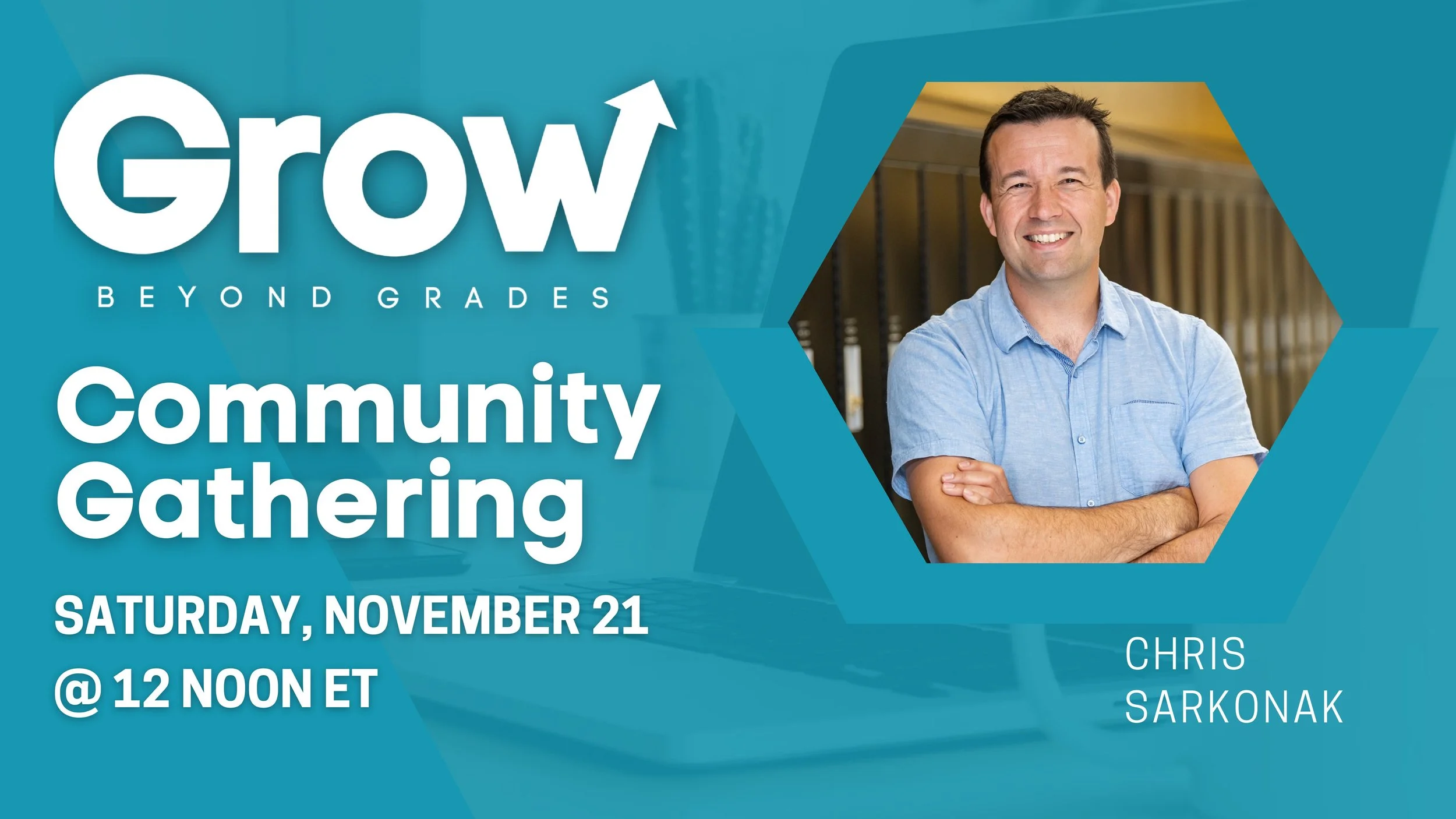
Christopher Sarkonak has spent 17 years teaching physics and mathematics—and much of that time experimenting with a question at the heart of Grow Beyond Grades: What if assessment worked more like learning itself?
A physics and science educator from Brandon, Manitoba, Chris has gradually moved away from traditional grading, through standards-based grading, and toward an approach built around student voice, portfolios, conferencing, co-constructed criteria, and opportunities to learn from mistakes. His goal is not simply to eliminate grades, but to create a classroom in which students have greater ownership of their learning and a clearer understanding of what growth actually looks like.
Scientists learn from mistakes. Yet our systems of assessment often punish students for making them.
— Chris Sarkonak
Chris’s work has recently received significant recognition. Just recently , he received a Prime Minister’s Award for Teaching Excellence in STEM, one of Canada’s highest honors for educators. He was also selected for the Robert E. Yager Foundation Excellence in Teaching Award from the National Science Teaching Association. These honors follow earlier recognition, including the Canadian Association of Physicists’ Award for Excellence in Teaching High School/CEGEP Physics.
At our next free online Community Gathering, Chris will join us to explore what happens when students become active participants in determining what learning—and ultimately a grade—looks like.
Together, we’ll consider questions like:
What happens when we ask students themselves what a grade should represent?
How can assessment allow students to make mistakes, take risks, and demonstrate growth rather than permanently recording every misstep?
How has standards-based grading helped—and where might it still reproduce some of the problems of traditional grading?
How can portfolios, conferences, and co-constructed criteria give students meaningful ownership without sacrificing rigor?
How do we assess the skills and dispositions we say we value—curiosity, collaboration, problem-solving, persistence—rather than simply what is easiest to measure?
What can teachers do when they want to move beyond grades but still work in systems that require them?
Chris is now pursuing a PhD in education at the University of Manitoba, extending his classroom work into research on assessment and educational change. His approach has also been recognized by the Government of Canada for helping students move beyond memorization toward deeper understanding, collaboration, independence, and intellectual risk-taking.
Chris’s journey is featured in our forthcoming Grow Beyond Grades book in his chapter, “Enough Failed Experiments: Rehumanizing Assessment in STEM.” Beginning with conversations in which his students consider what makes a good scientist, what learning actually means, and how grades make them feel, Chris traces the experiments—and failed experiments—that eventually led him toward a more collaborative and human approach to assessment.
His episode of the Grow Beyond Grades podcast will be released the Sunday before the gathering. We encourage you to listen beforehand and bring your questions, experiences, and curiosity!
Please RSVP to let us know you are coming. And help us spread the word!