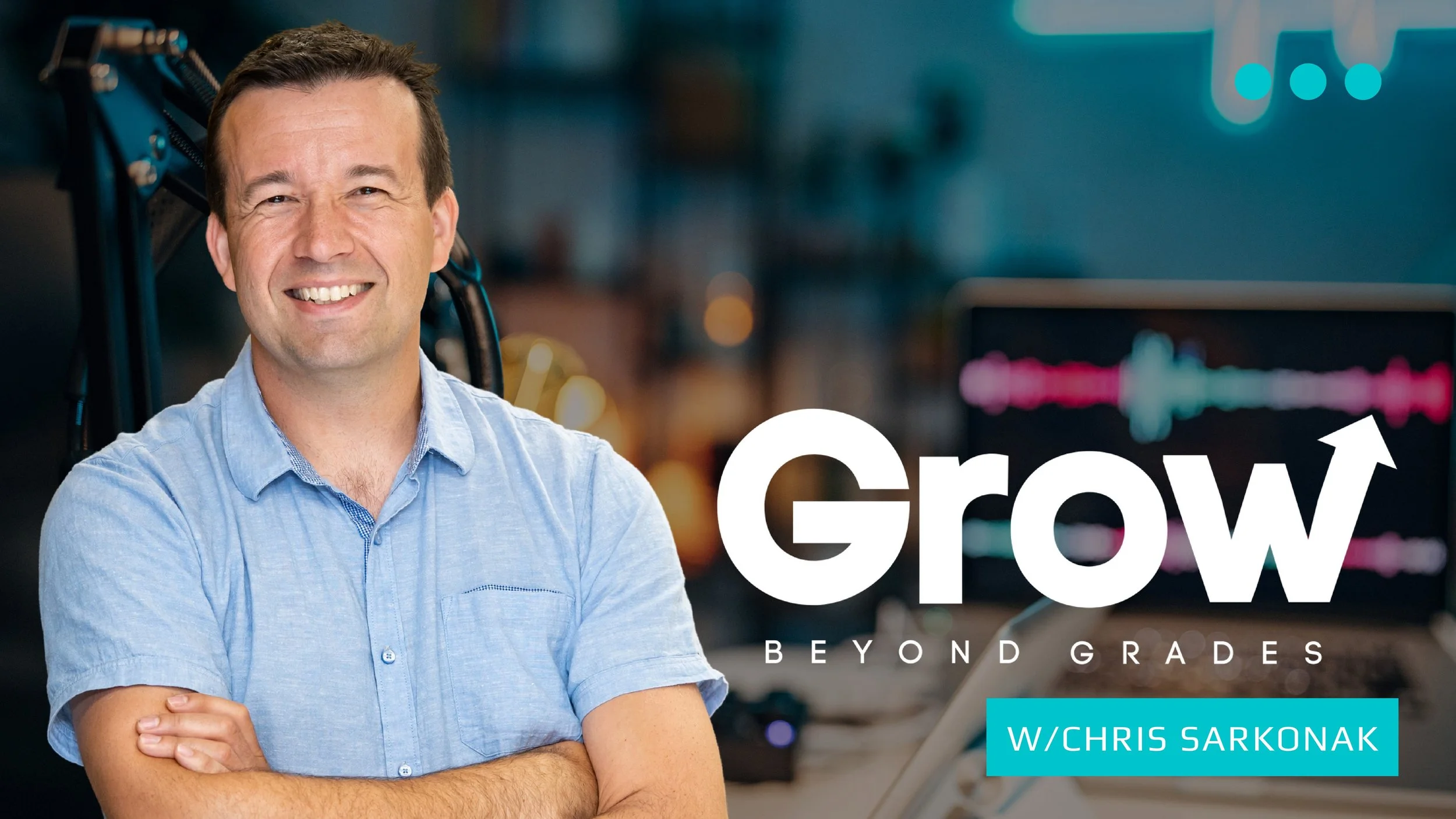
Join us for a free online Community Gathering with Chris Sarkonak on Saturday, November 21, at 12 noon ET. Please RSVP here to save your spot!
The best thing I can do for my students is if I’ve outlived my usefulness to them.
—Chris Sarkonak
What Does a Grade Look Like? Rethinking Assessment Like a Scientist
What if the qualities we say we value in learners—curiosity, creativity, collaboration, persistence, risk-taking—are exactly the qualities our assessment systems too often discourage?
For Canadian physics and mathematics teacher Christopher Sarkonak, that question has become central to a years-long process of rethinking assessment. Chris has moved from traditional grading, through standards-based grading, toward an approach built around student voice, portfolios, conferencing, co-constructed criteria, and opportunities to learn from mistakes.
In this conversation, Chris and I explore the experiments—and failed experiments—that led him there.
We talk about the moment he began questioning whether high grades actually represented deep learning, including two students whose very different classroom performances challenged his assumptions about what grades measure. Chris explains why standards-based grading helped him move forward but ultimately left some of the same problems intact—and shares a striking classroom experiment in which the exact same student work could produce a grade of 47%, 64%, or 73% depending entirely on how the gradebook was constructed.
At the heart of Chris’s thinking is a contradiction familiar to anyone who works in STEM: scientists learn by taking risks, making mistakes, revising ideas, and trying again, while school assessment often penalizes students for doing exactly those things.
We also get practical. Chris describes how guided labs, frequent feedback, portfolios, conferencing, and increasing student independence have changed what learning looks like in his classroom. Rather than offering his system as a model to copy, he argues that the deeper practice is listening to students and building assessment with them.
Chris’s work has recently received significant recognition, including a Prime Minister’s Award for Teaching Excellence in STEM and the Robert E. Yager Foundation Excellence in Teaching Award from the National Science Teaching Association. He is also pursuing a PhD in education at the University of Manitoba and is a contributor to the forthcoming Grow Beyond Grades book.
Topics
What students say when asked, “What does a grade look like?”
The qualities that make a good scientist—and whether traditional grading encourages them.
How Chris’s own identity as a successful student shaped his early teaching.
What two very different physics students taught him about grades and learning.
Why preparing students for future challenges does not require reproducing those challenges now.
Why scientists’ relationship with mistakes offers a useful lens for rethinking assessment.
What standards-based grading helped Chris change—and where it fell short.
How identical student performance can become radically different grades depending on gradebook design.
Using portfolios, conferencing, feedback, and co-constructed criteria to build greater student agency.
Why Chris does not want educators to carbon-copy his system.
What it means for students to become increasingly independent of both the teacher and the grade.
Why educators might benefit from thinking more like scientists themselves.
Join us for the Community Gathering:
Saturday, November 21 at 12 noon ET
https://growbeyondgrades.org/events/21nov26-community-gathering